
A six-level map reveals exactly where you stand on the stress-to-burnout continuum because most leaders struggle to distinguish mild strain from real danger. This article shares more about the six stress levels and allows you to establish where you are on the continuum.
Why “Just Tired” Falls Short
“Just tired” serves as a convenient phrase for busy leaders. It explains the short fuse, the flat weekend, and the ineffective morning coffee. It asks nothing of you because, theoretically, you rest and it passes.
The trouble arises because ordinary tiredness and early-stage stress feel almost identical internally. Tiredness lifts after a proper night of sleep. A stress response running quietly for months persists and rarely announces itself. It hides inside a life that still looks successful.
Most people treat stress as a binary state. You are either coping or burnt out. This binary thinking catches capable people off guard and explains why top performers often burn out last and hardest. By the time the word “burnout” feels accurate, the optimal moment to act has passed.
The Stress-to-Burnout Continuum
Stress accumulates and moves through distinct stages. A continuum lets you locate yourself and decide your next move. Mild strain and real depletion produce similar days on the surface, but they require entirely different responses. Willpower fails as a long-term strategy. Gripping tighter works early on but backfires later. The further along you are, the more effort costs you and the less it returns. Often it is the system, not your stamina, that needs the attention
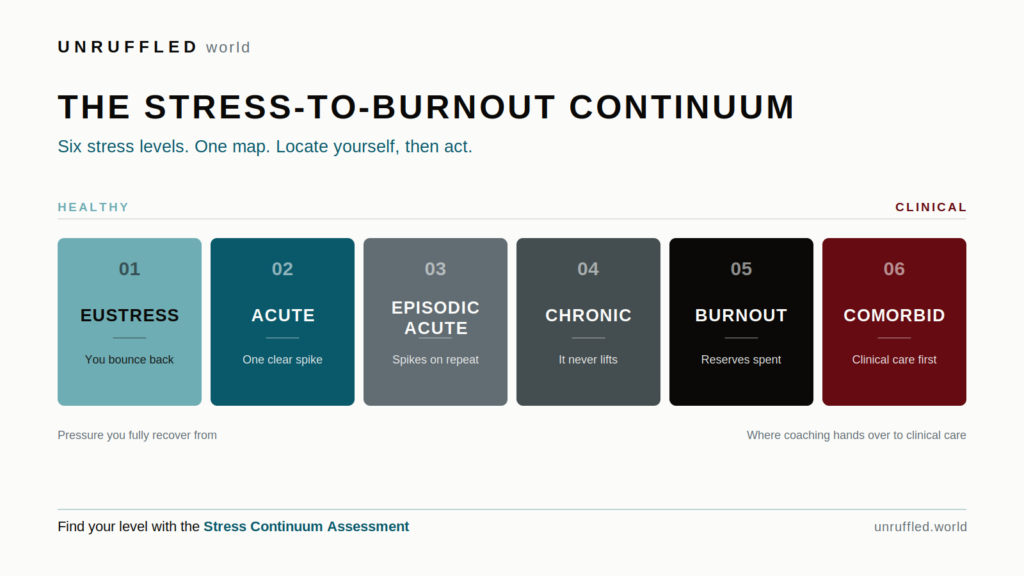
The six stress levels range from healthy to clinical:
- Eustress: Useful pressure you fully recover from.
- Acute stress: A short spike with a clear cause and end.
- Episodic acute stress: Acute stress arriving on repeat.
- Chronic stress: Pressure that never lifts and fades into the background.
- Burnout: The point where reserves are genuinely spent.
- Comorbid: Burnout alongside a clinical condition needing care.
1. Eustress: The Useful Edge
This represents stress working in your favor. Examples include a stretch goal, a live deadline, or a high-stakes pitch. Your focus sharpens and your energy rises before settling again. The defining marker of eustress is full recovery. Sleep and appetite remain normal, and you feel stretched rather than frayed. High performers thrive here. The key question is whether you still know how to come back down when the pressure lifts.
2. Acute Stress: The Spike
Acute stress features a clear cause and a defined endpoint, such as a board meeting or a critical quarterly target. Your body mobilizes. You run slightly hot, your mind races the night before, and your patience thins until the task concludes. This remains normal and harmless on its own. The vital signal is the curve following the spike. Settling within a day or two indicates you are fine. If the system stays switched on long after the event, take note.
3. Episodic Acute Stress: The Pattern
Spikes stop being isolated events and form a rhythm. There is always one more fire to put out and another deadline stacked on the last. Markers include a permanent sense of urgency, irritability that fails to reset between crises, tension headaches, and an overloaded schedule. Many wear this state as an identity, claiming to thrive under pressure. The hidden cost is the disappearance of recovery windows. You stop recovering between spikes and start living inside them.
4. Chronic Stress: The Background Hum
Pressure stops registering because it never lifts. It becomes the standard environment. The markers stay quiet, causing this level to be frequently missed. Sleep disruption becomes standard. Caffeine starts the day while something else ends it. Enthusiasm flattens into low, grey competence. Small illnesses linger and the body aches for no obvious reason. Physiology starts carrying the load, and the system governing your stress response loses its rhythm. You function visibly well, which perfectly conceals the underlying toll. This is the cycle of chronic stress and burnout taking hold.
5. Burnout: The Shutdown
Burnout occurs when reserves are genuinely empty. The World Health Organisation recognises it as an occupational phenomenon resulting from unmanaged chronic workplace stress. It manifests in three ways: deep exhaustion untouched by sleep, growing cynicism or distance from previously valued work, and a significant drop in effectiveness. You may still turn up, but performance runs on willpower and fumes with an empty tank. This stems from sustained load without recalibration.
6. The Comorbid Level: Overlapping Conditions
Burnout occasionally carries something clinical alongside it. Depression, an anxiety disorder, or another health condition can sit beneath the exhaustion and alter the entire picture. Markers include persistent low mood, loss of interest reaching beyond work, and bodily changes to sleep or appetite. This level requires a shift in support. Coaching supports recalibration alongside clinical care. It does not replace it, which is part of why burnout is not a DSM-5 diagnosis. If you recognise yourself here, the first step involves a doctor.
Locating Yourself Honestly
Reading the levels is straightforward. Placing yourself accurately proves challenging.
Common Pitfalls
- Comparison: High performers benchmark against extreme cases of visible collapse. Measured against a breakdown, almost everyone looks fine. The continuum asks where you sit today.
- The Good Week: Stress fluctuates. A self-check on a light Friday reads differently from a mid-quarter review. Rate yourself against your normal pattern over the past month.
- The Adaptation Trap: When a state persists long enough, it feels like your personality. Statements like ‘I have always been like this’ require examination because chronic stress excels at masquerading as temperament.
Questions for Clarity
- When pressure genuinely lifts, do you recover, or does the switched-on feeling remain?
- Are your recovery windows shrinking, and when did you last experience a real one?
- Are your sleep, energy, or patience quietly worse than a year ago?
- Would the people closest to you place you where you just placed yourself? (Those around you often read your state more accurately because they are not the ones performing the calm).
The useful questions are structural, and often self-care alone cannot fix a workplace that is burning you out.
What Each Level Needs
Locating yourself only helps if it changes your next action. A response fitting one level can actively harm another.
- Eustress: Guard the elements that allow recovery, such as sleep and boundaries.
- Acute and Episodic Acute Stress: Rebuild recovery windows. Deliberate recalibration earns its place here before the pattern hardens.
- Chronic Stress: Examine the load. Pushing harder worsens the situation. Systems often require attention rather than individual stamina.
- Burnout: Initiate genuine recalibration with proper support. Restoring depleted reserves takes precedence over productivity tweaks.
- Comorbid Level: Prioritise clinical care. Coaching provides supplementary support.
The earlier you act, the lighter the required response, preserving your clarity, calm, energy, and resilience. Vague problems like being “just tired” rarely get solved. Identifying your exact location on the continuum provides a clear next step.
If you want a clearer read than a quick self-scan can give, the Stress Continuum Assessment places you on the continuum with proper structure and scoring, then points you to what your level actually needs. It takes a few minutes.
