

The questions we ask when we can’t hide it anymore
When burnout finally gets loud enough to notice, almost everyone reaches for the same question: what’s wrong with me?
This is a theme with many variations:
- Why can’t I keep up the way I used to?
- Why does work that once felt manageable now feel like wading through wet sand?
- Why am I the one running out of road when the person at the next desk seems fine?
The problem with these questions is that they arrive already carrying their own verdict. That verdict always boils down to a belief that the problem is a personal deficiency. Somewhere, we reason to ourselves, we have a shortfall of grit or resilience or character. So of course, we can fix it by trying harder or wanting it more.
This is exactly the wrong frame, and decades of research say so.
The more accurate question, the one that actually leads somewhere, is: what’s wrong with the conditions?
Burnout is a sustained mismatch between people and the environments they work in. The exhaustion is real. The cynicism is real. The sense of diminished effectiveness is real. But they are responses to something, not evidence of a flaw that you are bringing to your work.
“You can’t work your way out of this” is, paradoxically, not what high-achievers typically want to hear. But it is nevertheless true, and it’s what this article is all about.
What the research shows us
The person who has spent the longest looking at this is Christina Maslach, the Berkeley psychologist whose name is on the most widely used burnout measure in the world. Her work, along with that of her collaborator Michael Leiter, produced a finding that has held up across occupations, countries and decades: burnout is a response to chronic stressors in the workplace.
That chronic is doing a lot of work. Burnout doesn’t come from one brutal week or one impossible project. It’s what accumulates when demanding conditions never resolve: when the gap between what a job asks and what it gives back stays open long enough to become the permanent weather of someone’s working life.
For a long time the research framed burnout mainly through the individual experiencing it. Maslach and Leiter’s most useful move was to turn the lens around and ask what it is about work itself that reliably produces this state. The answer is more complex than long hours and bad managers. It was a relationship: the fit, or the mismatch, between a person and six specific features of their job.
The six places work goes wrong
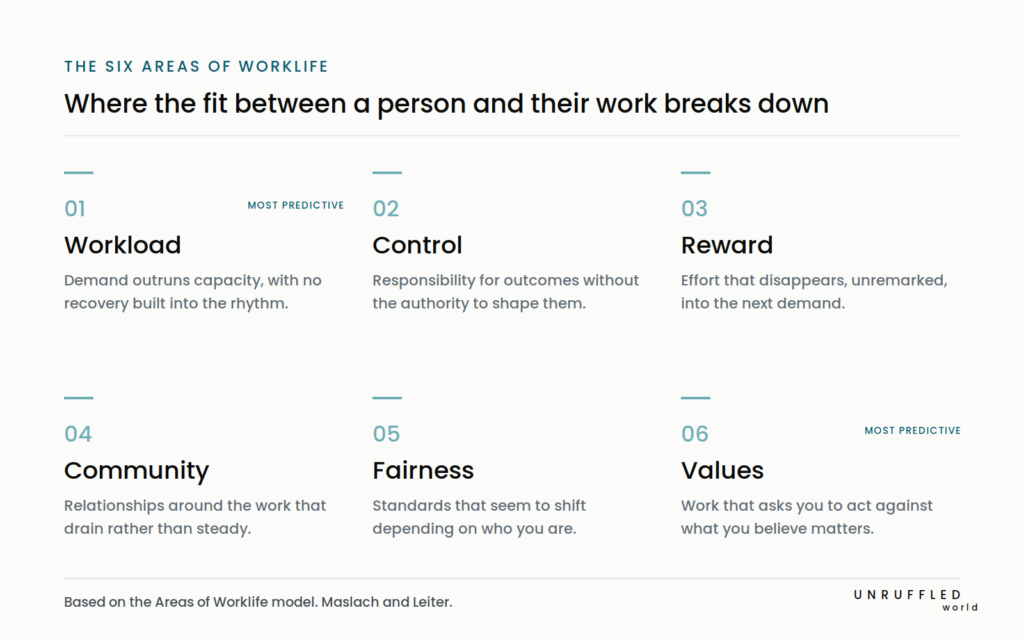
Maslach and Leiter identified six areas where the fit between a person and their job tends to break down. Burnout rarely comes from just one. It’s usually a compound of two or three, each individually survivable, together corrosive.
1: Workload
The most obvious, and the one people name first. Not simply a lot of work, but a sustained excess of demand over capacity, with no recovery built into the rhythm. A heavy week is fine if the body and mind get to come back down afterwards. A heavy year, with the return to baseline never quite arriving, is how depletion sets in. Of all six, workload is one of the two most consistently tied to burnout in the research.
2: Control
How much say you have over how you do your work. When people have autonomy they absorb far more pressure without breaking. But place those same people under a micromanagement regime, or hold them responsible for outcomes they have no authority to influence, and the same workload will become heavier. Powerlessness is exhausting in a way that difficulty alone is not.
3: Reward
Financial reward is part of this point, and not a small one. But it also includes factors like recognition of effort. A great deal of burnout grows in environments where people work hard and well and the effort simply disappears, unremarked, into the next demand. “Around here, the reward for good work is more work” is the kind of inside joke people make to paper over a deep discomfort about incentives.
4: Community
This one is about the quality of the relationships around the work. When these are good, you have a sense of being among people rather than against them. Isolation or unresolved conflict engender the opposite feeling. They corrode the social buffer that otherwise helps people withstand strain. Who you work with can protect you or drain you. In both cases, the impact is enormous and underestimated.
5: Fairness
It’s worth taking a step back and asking whether your workplace is just. Is the decision-making process transparent? Does the organisation distribute rewards even-handedly? If you perceive that different standards apply to different people, this will accelerate burnout.
Unfairness is uniquely corrosive because it carries a message: that you are not fully respected here. People will endure a great deal and still recover. But being treated unfairly while doing it is what turns endurance into resentment.
6: Values
There are things that matter to you. And there are things your work asks you to do. These two have to overlap, to some degree. This is the deepest of the six, and alongside workload, one of the two most predictive. When people are required to act against their own sense of what’s right or worthwhile, the daily friction of that misalignment wears them down. Even people who are otherwise well supported will eventually feel this clash acutely.
Importantly, each of these is a property of the environment. At least in principle, they’re all things that an organisation can change.
The pebble in the shoe
Like any metaphor, the word “burnout” is useful but not neutral. It smuggles in the idea of fire, which naturally leads us to associate the phenomenon with something dramatic. And while it’s true that large crises at work can accelerate a descent towards burnout, they’re not the only way to get there.
More often, burnout from something much smaller and much harder to point at, or a series of these distinctly undramatic steps.
Think about the difference between a broken leg and a pebble in your shoe. The broken leg is agony, but it’s obvious, so you get treatment for it. The pebble is almost nothing. But walk on it for a mile and it will change how you move, until your whole gait is compensating and your hip aches and you’ve forgotten what walking normally even felt like.
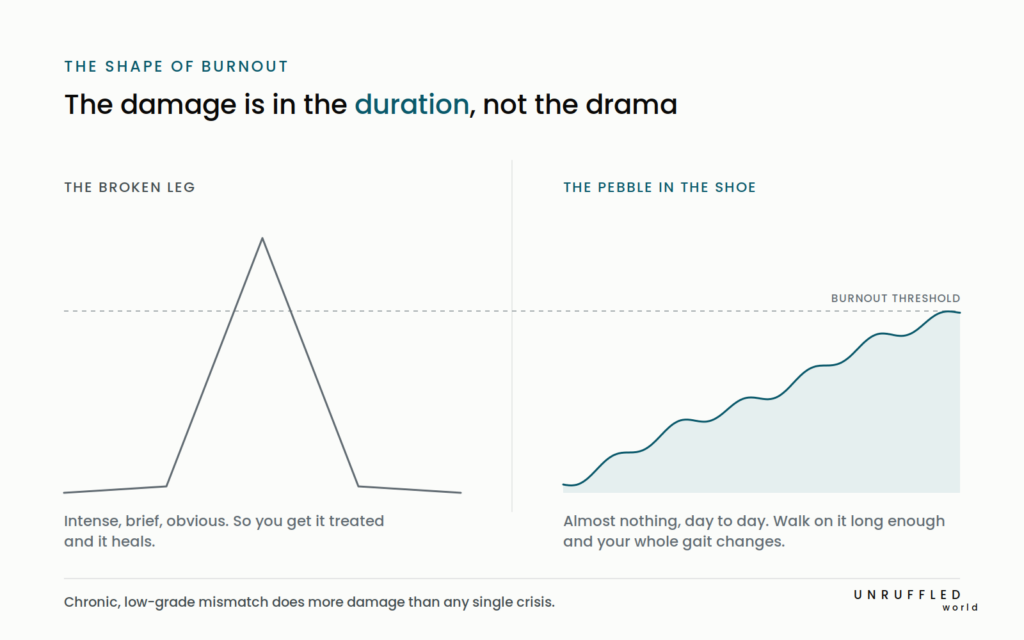
Many workplace stressors are like that. The status meeting that always runs long and never decides anything is annoying. But it feels too trivial to complain about. Add a handful of these irritants together and you have the beginnings of burnout. You end up with a slow accumulation of small compensations, each one costing a little more energy than the last. The damage is in the duration, not the drama.
Why self-care isn’t the fix
Here is where the systemic view collides with almost everything the wellness industry sells.
If burnout comes from the mismatch between a person and six features of their environment, then the standard prescriptions aim at the wrong target. There’s nothing harmful about a yoga class or a resilience workshop, but they won’t fix this problem.
They ask the person to change so they can better tolerate conditions that were the actual problem all along. At best, they help someone withstand a little more before breaking. At worst, they subtly reinforce the very message that caused the shame in the first place: if you’re still struggling, you haven’t self-cared hard enough.
A caveat: take the yoga class
This isn’t an argument against looking after yourself. Recovery, rest and personal regulation matter enormously. But self-care cannot fix a workload problem. It cannot make an unfair system fair, or restore control to someone who has none, or resolve a values conflict that grinds a little deeper every day. Asking it to do so is like handing someone a better umbrella and calling it a fix for the leaking roof.
The umbrella is worth having. It was just never going to fix the roof.
So what can leaders change?
The systemic view is sometimes heard as fatalism. After all, if the system is the problem, what’s the point? But thankfully, precisely the opposite is true. A problem located in conditions is a problem with levers.
Here are the real ones.
Start by finding the actual mismatch
The six areas are a useful diagnostic. Before reaching for a solution, work out which of the six a person or team is grappling with. The fixes for each of them are different, and treating a fairness problem with a workload intervention wastes everyone’s effort. Ask, and be willing to hear the answer.
- On workload: protect recovery as deliberately as you assign work. Build genuine downtime into the rhythm rather than treating it as slack to be eliminated. Watch for the person whose output is still excellent, because they are often the furthest along and the least likely to say so.
- On control: hand back autonomy wherever the stakes allow. Let people decide how even when the what is fixed. Notice where you’ve made someone accountable for something they can’t actually influence, and either give them the authority or stop holding them to it.
- On reward: make good work visible. Recognition costs almost nothing and is chronically underused. Ensure the return on effort (pay, yes, but also acknowledgement and opportunity) bears some honest relationship to what people put in.
- On community: treat the social fabric as real infrastructure, because it is. Address the corrosive conflict you’ve been letting slide. Protect the connections that let people feel they’re among allies rather than rivals.
- On fairness: make decisions transparently and apply rules evenly, especially the ones about who gets stretched and who gets protected. Nothing erodes trust faster than the perception that effort and reward are handed out arbitrarily.
- On values: stop asking people to act against what they believe matters. Where the work genuinely conflicts with someone’s sense of worth or ethics, no perk compensates for it, and no resilience training resolves it.
Not every one of these levers sits with leadership alone, of course. Individuals can renegotiate their own boundaries, relationships and rhythms. In fact, some of the most durable change happens there. But a leader who treats these six as their responsibility is a leader whose people don’t burn down while still delivering.
Change the question, change the outcome
Everything in this article follows from a single move: turning the question from what’s wrong with me? to what’s wrong with the conditions?
That move does two things at once. It lifts the shame, because a mismatch between a person and an environment is nobody’s character defect. It’s a fit problem, and fit can be adjusted. And it opens the door to solutions that actually work, because you can’t change a condition you’ve misidentified as a personal weakness. The people most vulnerable to burnout are frequently the most committed and capable, which is exactly why framing it as their failing is both wrong and expensive.
If you want to go deeper, the pieces in this series each take one thread further:
The real biology of depletion, and why self-care falls short. And if burnout has no diagnostic code (which, as we explain elsewhere, it deliberately doesn’t), that’s not because it isn’t real. It’s because the manuals are pointing where this article has been pointing all along: at the system, not your stamina.
The most useful next step is to find out where you, or your team, actually sit. {Request an assessment} to map it against the six areas. You can only change a condition once you know which one is broken.
