

There’s a particular kind of exhaustion that doesn’t show up on the surface. You’re still delivering. The work is still good; it may even be your best work. The team still comes to you when something needs to be handled properly, because you’re that person.
But underneath, you’re not at ease. What used to feel like momentum now feels like force. As energy leaves, you’ve had to substitute will. And running on will is expensive.
This is the high performer’s paradox: the people most likely to burn out are often the last to notice. Like a waterbird (poised on top, thrashing below the waterline), they’re effective at maintaining both the appearance (and even the reality) of competence and forward movement. But this has limits.
If you’re reading this and recognising yourself, you’re not imagining it. You may just be further along a process that, by design, you were never going to notice early.
High performers are not good at noticing the signs of impending burnout
Burnout, for most people, announces itself. Performance drops, motivation visibly wanes, and the people around them tend to notice before too long. There’s a natural early-warning system built into ordinary underperformance.
High performers don’t get that warning system. Three things conspire to keep it switched off.
Competence
A high performer running on empty still tends to outperform most people running at full capacity. Their floor is everyone else’s ceiling. A less driven person may show very obvious signs of burnout earlier, like a visible drop in output or reliability. In contrast, high performers stay healthy long after the internal experience has stopped being sustainable. This is why the work is the last thing to go, not the first.
Identity
For a lot of high performers, being the person who handles things is central to who they understand themselves to be. For someone else, admitting depletion is simply a matter of reporting a problem. But for the high performing individual, it cuts closer to the bone. It can feel as if they are conceding something about their own character. Instead of naming that, they reframe it, drawing on a rich vocabulary of watchwords: busy quarter, rough patch.
Praise
The people around a high performer are still getting excellent work, and they reflect that back. “Good job, don’t know how you do it. That feedback feels good, and it should. But it also confirms the identity that’s driving the overextension in the first place. The validation and the depletion emerge through the exact same behaviour, at the exact same time.
These three together leave you with a long runway that has no warning lights. The signals are there, but there is every incentive in the world to interpret them as proof that everything is fine.
The biology of running on reserves
Stress is supposed to come and go. Something demanding happens, and your body rises to meet it. Then, once it’s over, you come back down. Spike, then recovery, is the system working as it should. This is what got you through every deadline you’ve ever made.
The trouble starts when the demand never really lets up. For a high performer, there’s always another deadline, sometimes more than one running concurrently. High performers will always find another standard to hold, another version of themselves to maintain or improve. The body never quite gets the signal that it’s safe to stand down. So it stays switched on, and staying switched on indefinitely has a cost.
“My spark is gone”
The first thing to go is usually that thing you can’t quantify, the je-ne-sais-quois that you rely on and that others recognize. Usually, you find new projects and even tough problems energizing. But it all starts to feel flat, muted. This is one of the crueller aspects of burnout: the very drive that made someone excellent starts to fade quietly, while the output is still good enough that nobody notices, including them.
“I just…don’t know, you know?”
Next goes the clarity. Decisions that used to be easy start to feel foggy. Small frustrations land harder than they should. People describe it as feeling thin-skinned, or like their fuse got shorter without their permission.
“Something isn’t right”
Sleep stops doing its job. Eight hours in bed, and you wake up just as tired as when you lay down. After all, real rest needs your body to fully stand down, and it’s forgotten how. The body starts talking in other ways, too: Headaches, gut issues, catching every cold going around.
None of this happens overnight. It’s a slow accumulation, a kind of debt building while everything still looks fine on the surface. We go deeper into this mechanism, and what it takes to actually pay that debt down, in a dedicated piece. For now, the point is that this is physiology, not character. Which means the fix has to be physiological too.
Six stress levels, at a glance
If burnout is an accumulation, it helps to know where you sit on the way there. As we all know, stress doesn’t jump from fine to collapsed. There’s a wide range between those two, and your stress levels progress through recognisable stages.
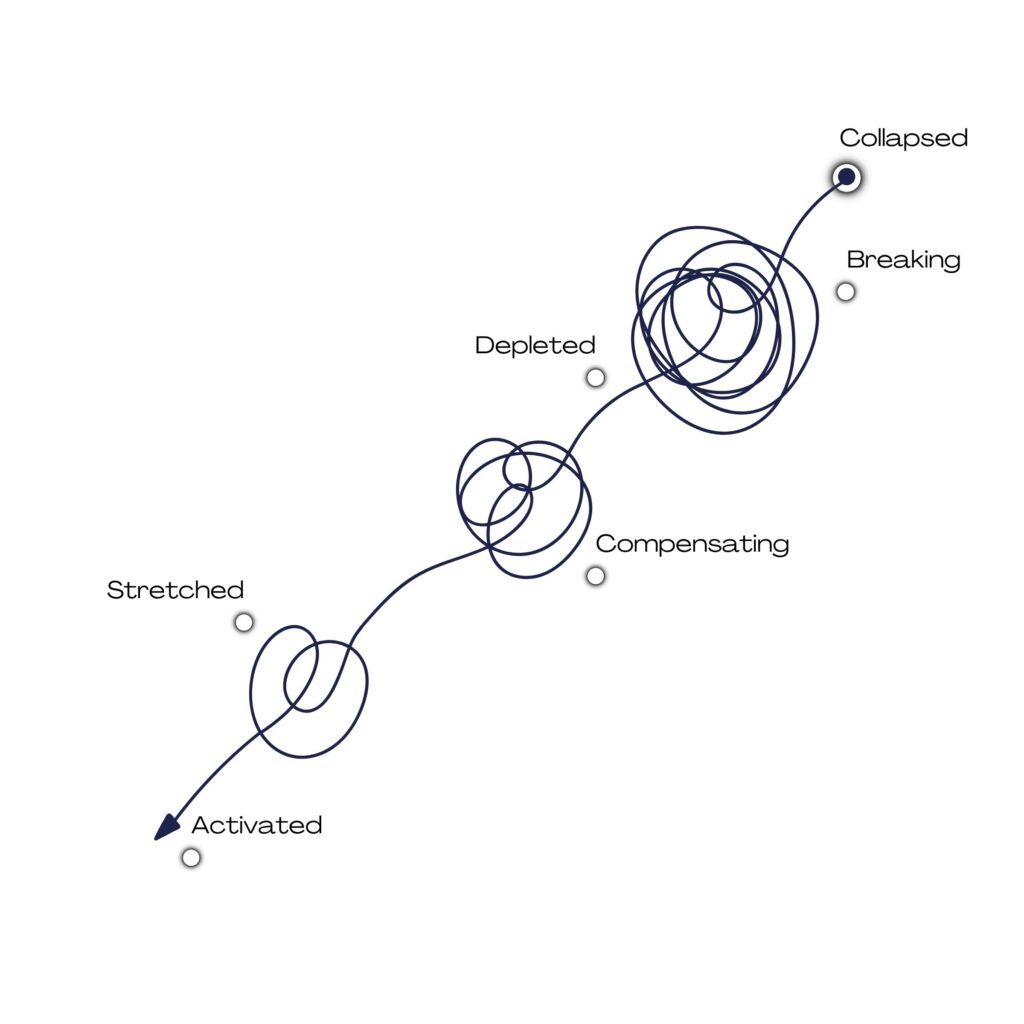
It can be difficult to place yourself on that continuum, until you see it laid out in relation to the other stages.
- Activated. This is healthy stress. It’s the kind that sharpens focus and drives good work. You feel challenged (which is not the same as feeling depleted). Recovery happens naturally and usually in a short period.
- Stretched. At this point, the demands are slightly outpacing the recovery. You’re still performing well, but you notice yourself needing more to bounce back. For example, you want a quiet weekend, not just a night’s sleep.
- Compensating. If you’re a high performer, this is probably where you spend a dangerous amount of time. Output is still strong, but you’re propping it up by sheer effort rather than genuine capacity. You’re capable of making that titanic effort, which, paradoxically, is the problem. The spark described earlier starts to dim here, even though almost nobody else can tell.
- Depleted. The compensation starts to cost more than it returns. The high performer at this stage starts to feel less clear and less patient. The resilience they rightfully pride themselves on starts to wear thin.
- Breaking. Performance starts to visibly slip, in ways that are no longer possible to mask. This is usually the first point at which the issue becomes obvious to colleagues or family. But it’s the 5 stop on this journey, far later than when it actually started.
- Collapse. Function gives way. This can look like illness, or a sudden inability to continue at all. It often appears sudden to everyone watching, including the person it’s happening to. It has never actually been sudden. It’s the moment compensation finally runs out.
Most high performers don’t recognise themselves until stage four or five, because stages two and three are specifically the ones that still look like success from the outside. We unpack each stage, and the signs that distinguish them, in more detail elsewhere. But before you go on reading, think seriously about whether any of these feel like you right now.
Treat your stress environment as an interesting problem to solve
An important shift happens when highly conscientious people apply their problem-solving power to their own system. That begins with an awareness of the limits of both capacity and will. Admitting those limits doesn’t come naturally to high-performing people, but curiosity does. Our assessment process leverages that natural curiosity to help highly driven people to understand and start dismantling the barriers to balance.
Reach out here to learn more.
